
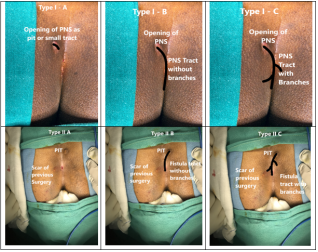
Background: Pilonidal sinus is quite common in young hairy males. Inspite of it’s common occurrence there is no universally accepted classification of pilonidal sinus. PNS is a known disease from the time of Sushruta 1600 BCE but no one thought about classifying it. Objective: We developed a classification of pilonidal sinus, Nigam’s classification of pilonidal sinus (NCP), which is ideal for categorization of PNS and also guiding surgical treatment. NCP is based on anatomical, clinical and radiological (MRI) details. Design: Prospective Cohort design. Systemic reviews of existing literature about pilonidal sinus were done thoroughly. We considered existing limitations, gaps in diagnostic, therapeutic and prognostic value of existing classification of pilonidal sinus. Settings: The study primarily was done in Max Hospital, Gurgaon, Haryana, India. Out patient and radiology departments were mainly concerned. Patients: A total of 230 patients of chronic pilonidal sinus were studied between January 2001 to September 2026. Age, gender and BMI were recorded but not considered for exclusion. Patients of acute abscess with pilonidal sinus were not included in this study. Intervention (s): All patients were subjected to history taking, physical examination and MRI study. No probing or any other interventional process was done. Main outcome measures: NCP focuses on it’s validity, reliability, clinical utility, and patient prognosis along with guidance to surgical treatment, NCP excels over existing classifications to pilonidal sinus in diagnostic and therapeutic decision-making. Results: In this study of 230 cases, 110 (48%) patients belonged to Type I of NCP and 120(52%) patients belonged to Type II of NCP. Most of patients were male, 208 (90.5%) between 21-30 years of age, 124 (53.9%). Limitations: Patients of acute abscess with PNS were not included in this study. Conclusions: Nigam’s classification of pilonidal sinus is an ideal simple and result oriented classification with therapeutic decision-making guidance.
| Published in | International Journal of Gastroenterology (Volume 10, Issue 2) |
| DOI | 10.11648/j.ijg.20261002.17 |
| Page(s) | 116-123 |
| Creative Commons |
This is an Open Access article, distributed under the terms of the Creative Commons Attribution 4.0 International License (http://creativecommons.org/licenses/by/4.0/), which permits unrestricted use, distribution and reproduction in any medium or format, provided the original work is properly cited. |
| Copyright |
Copyright © The Author(s), 2026. Published by Science Publishing Group |
Abscess, Chronic, MRI, Nigam’s Classification, Pilonidal Sinus
BCE | Before Christ Era |
BMI | Body Mass Index |
ICD | International Classification of Diseases |
IPS | International Pilonidal Sinus Society |
MRI | Magnetic Resonance Imaging |
NCP | Nigam’s Classification of Pilonidal Sinus |
NHS | National Health Service |
PD | Pilonidal Sinus Disease |
PNS | Pilonidal Sinus |
PSD | Pilonidal Sinus Disease |
| [1] | Mayo OH. Observations on injuries and Diseases of the Rectum. London: Bergers and Hill 1833. |
| [2] | Corman ML. Classic articles in colonic and rectal surgery. Pilonidal Sinus. Dis Colon Rectum, 1981; 24: 324-326. |
| [3] | Hodges RM. Pilonidal sinus, Boston Med Surg J. 1880; 103: 485-486. |
| [4] | Shekhar M. Application of Ksharsutra in the management of Nadi Vrana (Pilonidal Sinus): A case study. Int J Ayush. 2020; 9(3): 10-14. |
| [5] | Johnson EK, Vogel JD, Cowan ML, Feingold DL, Steere SR. Clinical Practice Guidelines, Committee of the American society of Colon and Rectal Surgeon. The American Society of Colon and Rectal Surgeon’s Guidelines for the Management of Pilonidal Disease. Dis Colon Rectum. 2019 Feb; 62(2): 146-157. |
| [6] | Shabber J, Choudhary BN, Britton DC. Management of sacrococcygeal pilonidal sinus disease: a snapshot of current practice. Int J. Colorectal Dis 2011; 26: 1619-1620. |
| [7] | Choy K, Srinath H. Pilonidal disease: an update. Aus J Gen Prac. 2019; 48(3): 116-118. |
| [8] | Sondena K, Andersen E, Nesvik I, Soreide JA. Patient characteristics and symptoms in chronic pilonidal sinus disease. Int J Colorectal Dis. 1995; 10(1): 39-42. |
| [9] | Akinci OF, Bozer A, Uzunkoy, et al. Incidences ang Turkish soldiers. Eur J Surg. 1999; 165(4): 339-342. |
| [10] | Evers T, Doll D, Matevossian E, Noe S, Neumann K, Li H, et al. Trends in incidence and long-term recurrence rate of pilonidal sinus disease and analysis of associated influencing factors. Zhonghua Wai Ke Za Zhi. 2011; 49: 799-803. |
| [11] | daSilva JH. Pilonidal cyst: cause and treatment. Dis Colon. 2000 Aug; 43(8): 1146-56. |
| [12] | Gage M. Pilonidal sinuses: an explanation of its’ embryologic development. Arch Surg. 1939; 109: 291-303. |
| [13] | Kanat BH, Sozen S. Disease that should be remembered: Sacrococcygeal pilonidal sinus disease and short history. World J Clin Cases. 2015 Oct 16; 3(10): 876-879. |
| [14] | Patey DH, Scarff RW. Pathology of Postanal Pilonidal Sinus: It’s Bearing on Lancet Treatment 1946; 2: 484-486. |
| [15] | Bascon J Pilonidal disease: origin from follicles of hairs and results of follicle removal as treatment surgery. 1980; 87: 567-572. |
| [16] | Karydakis GE. Easy and successful treatment of pilonidal sinus after explanation of causative process. Aust NZJ Surg. 1992 May; 62(5): 385-9. |
| [17] | Nigam VK, Nigam S. Nigam’s Procedure for Pilonidal Sinus – A Zero Recurrence Technique. Glob J Surg Case Rep. Jan 10, 2025. |
| [18] | Khanna A, Rombeau JL. Pilonidal Disease. Clin Colon Rectal Surg. 2011 Mar; 46-53. |
| [19] | Boulanger G, Abet E, Brau-Weber AG, Lechair F, Denimal F, Jean MH, et al. Is histological analysis of pilonidal sinus useful? Retrospective analysis of 731 resections. Journal of Visceral Surgery. 2018 Jun; 155(3): 191-194. |
| [20] | Luedi MM, Schober P, Stauffer VK, Diekmann M, Andereggen L, Doll D. Gender-specific prevalence of pilonidal sinus disease over time: A systematic review and meta-analysis. ANJ Journal of Surgery, 2021 Jul; 91(7-8): 1582-1587. |
| [21] | Yildiz T, Elmas B, Yacak A, Turgut HT, Ice Z. Risk factors for pilonidal disease interchanges. Ind J Pediatr, 2017; 84(2): 134-138. |
| [22] | Jeffery LR, Farzanch C, Christopher JN. Genome-Wide Association Study Identifies Genes for Hair Growth and Patterning are Associated With Pilonidal Disease. Dis Colon & Rectum 2024 Jun 20; |
| [23] | Omer FA, Mehmet K, Alpaslan T, Ibrahim A, Ismail ES, Oguz A. Natal Cleft Deeper in Patients with Pilonidal Sinus. Implications of Choice of Surgical Procedure. Dis Colon Rectum. 2009 May; 52(5): 1000-1002. |
| [24] | Bosche F, Luedi MM, Van der Zypers D, Moersdorf P, Krapohi B, Doll D. The Hair in the Sinus: Sharp-Ended Rootless Head Hair Fragments can be Found in Large Amounts in Pilonidal Sinus Nests. World J Surg. 2018 Feb; 42(2): 567-573. |
| [25] | Cubukcu A, Gonullu NN, Ozby O etal. The role of obesity on the recurrence of pilonidal sinus disease in patients, whowere treated by excision and Limberg flap transposition. Int J Colorectal. Dis. 2000 Jul; 15: 173-175. |
| [26] | Chintapatta S, safarani N, Kumar S, et al. Sacrococcygeal pilonidal sinus: historical review, pathological insight and surgical options. Techniques in Coloprotology. 2023; 7: 3-8 |
| [27] | Bolandparvez S, Moghadam DP, Salahi R, et al. Evaluation of the risk factors of pilonidal sinus: a single center experience. Turk J Gastroenterol. 2012; 23(5): 535-537. |
| [28] | Sievart H, Evers T, Matevossian E, Hoenmann C, Hoffman S, Doll D. The influence of lifestyle (smoking and body mass index) on wound healing and long-term recurrence rate in 534 primary pilonidal sinus patients. Int J Colorectal Dis: 2013; 28: 1555-1562. |
| [29] | Johnson EK. Pilonidal disease and hidradenitis suppurativa. In Steele S, Hull T, Read T, Saclarides T, Senagore A, Whitlow C (eds). The ASCRS textbook of colon and rectal surgery. Springer, Cham. |
| [30] | Quinodoz PD, Chilcott M, Grolleau JL, Chavoin JP, Costa-gliola M. Surgical treatment of sacrococcygeal pilonidal sinus disease by excision and skin flaps: the Toulouse experience Eur J Surg. 1999; 165(11): 1061-1065. |
| [31] | Zorlu M, Sahiner IT, Zobaic E, Kocak C, Yasti AC, Dolapcion. Early results with the Mutaf technique: a novel off-midline approach in pilonidal sinus surgery. Ann Surg Treat Res. 2016; 90(5): 265-7. |
| [32] | Brown SR, Lund JN. The evidence base for pilonidal sinus surgery is the pits. 2019 Dec; 23(12): 1173-1175. |
| [33] | Lee MJ, Lee E, Bradburn M, Hind D, Strong EB, Din F, et al. Classification and stratification in pilonidal sinus disease: fundings from the PITSTOP Cohort. Colorectal Disease, 2024 April 21; 27(1): e16989. |
| [34] | Tezel E. A new classification according to navicular area concept for sacrococcygeal pilonidal disease. Colorectal Disease. 2007 June 15; 9(6): 575-576. |
| [35] | Doll D, Vassiliu P. Another pilonidal classification – PLATIN. Pilonidal Sinus J (Internet) 2018; 4(1): 1-3. |
| [36] | Irkorucu O. Management of pilonidal disease: Before you compare, use a classification system. Asian J Surg. 2016 Oct; 39(4): 260-1. |
| [37] | Guner A, Cekic AB, Boz A, Turkyilmaz S, Kucuktulu U. A proposed staging system for chronic symptomatic pilonidal sinus disease and restuls in patients treated with stage-based approach. BMC Surg 2016 Apr; 16: 18. |
APA Style
Nigam, V. K., Nigam, S. (2026). Nigam's Classification of Pilonidal Sinus (NCP) – An Ideal Grading System for Pilonidal Sinus (PNS). International Journal of Gastroenterology, 10(2), 116-123. https://doi.org/10.11648/j.ijg.20261002.17
ACS Style
Nigam, V. K.; Nigam, S. Nigam's Classification of Pilonidal Sinus (NCP) – An Ideal Grading System for Pilonidal Sinus (PNS). Int. J. Gastroenterol. 2026, 10(2), 116-123. doi: 10.11648/j.ijg.20261002.17
@article{10.11648/j.ijg.20261002.17,
  author = {Vinod Kumar Nigam and Siddharth Nigam},
  title = {Nigam's Classification of Pilonidal Sinus (NCP) – An Ideal Grading System for Pilonidal Sinus (PNS)},
  journal = {International Journal of Gastroenterology},
  volume = {10},
  number = {2},
  pages = {116-123},
  doi = {10.11648/j.ijg.20261002.17},
  url = {https://doi.org/10.11648/j.ijg.20261002.17},
  eprint = {https://article.sciencepublishinggroup.com/pdf/10.11648.j.ijg.20261002.17},
  abstract = {Background: Pilonidal sinus is quite common in young hairy males. Inspite of it’s common occurrence there is no universally accepted classification of pilonidal sinus. PNS is a known disease from the time of Sushruta 1600 BCE but no one thought about classifying it. Objective: We developed a classification of pilonidal sinus, Nigam’s classification of pilonidal sinus (NCP), which is ideal for categorization of PNS and also guiding surgical treatment. NCP is based on anatomical, clinical and radiological (MRI) details. Design: Prospective Cohort design. Systemic reviews of existing literature about pilonidal sinus were done thoroughly. We considered existing limitations, gaps in diagnostic, therapeutic and prognostic value of existing classification of pilonidal sinus. Settings: The study primarily was done in Max Hospital, Gurgaon, Haryana, India. Out patient and radiology departments were mainly concerned. Patients: A total of 230 patients of chronic pilonidal sinus were studied between January 2001 to September 2026. Age, gender and BMI were recorded but not considered for exclusion. Patients of acute abscess with pilonidal sinus were not included in this study. Intervention (s): All patients were subjected to history taking, physical examination and MRI study. No probing or any other interventional process was done. Main outcome measures: NCP focuses on it’s validity, reliability, clinical utility, and patient prognosis along with guidance to surgical treatment, NCP excels over existing classifications to pilonidal sinus in diagnostic and therapeutic decision-making. Results: In this study of 230 cases, 110 (48%) patients belonged to Type I of NCP and 120(52%) patients belonged to Type II of NCP. Most of patients were male, 208 (90.5%) between 21-30 years of age, 124 (53.9%). Limitations: Patients of acute abscess with PNS were not included in this study. Conclusions: Nigam’s classification of pilonidal sinus is an ideal simple and result oriented classification with therapeutic decision-making guidance.},
 year = {2026}
}
TY  - JOUR
T1  - Nigam's Classification of Pilonidal Sinus (NCP) – An Ideal Grading System for Pilonidal Sinus (PNS)
AU  - Vinod Kumar Nigam
AU  - Siddharth Nigam
Y1  - 2026/11/16
PY  - 2026
N1  - https://doi.org/10.11648/j.ijg.20261002.17
DO  - 10.11648/j.ijg.20261002.17
T2  - International Journal of Gastroenterology
JF  - International Journal of Gastroenterology
JO  - International Journal of Gastroenterology
SP  - 116
EP  - 123
PB  - Science Publishing Group
SN  - 2640-169X
UR  - https://doi.org/10.11648/j.ijg.20261002.17
AB  - Background: Pilonidal sinus is quite common in young hairy males. Inspite of it’s common occurrence there is no universally accepted classification of pilonidal sinus. PNS is a known disease from the time of Sushruta 1600 BCE but no one thought about classifying it. Objective: We developed a classification of pilonidal sinus, Nigam’s classification of pilonidal sinus (NCP), which is ideal for categorization of PNS and also guiding surgical treatment. NCP is based on anatomical, clinical and radiological (MRI) details. Design: Prospective Cohort design. Systemic reviews of existing literature about pilonidal sinus were done thoroughly. We considered existing limitations, gaps in diagnostic, therapeutic and prognostic value of existing classification of pilonidal sinus. Settings: The study primarily was done in Max Hospital, Gurgaon, Haryana, India. Out patient and radiology departments were mainly concerned. Patients: A total of 230 patients of chronic pilonidal sinus were studied between January 2001 to September 2026. Age, gender and BMI were recorded but not considered for exclusion. Patients of acute abscess with pilonidal sinus were not included in this study. Intervention (s): All patients were subjected to history taking, physical examination and MRI study. No probing or any other interventional process was done. Main outcome measures: NCP focuses on it’s validity, reliability, clinical utility, and patient prognosis along with guidance to surgical treatment, NCP excels over existing classifications to pilonidal sinus in diagnostic and therapeutic decision-making. Results: In this study of 230 cases, 110 (48%) patients belonged to Type I of NCP and 120(52%) patients belonged to Type II of NCP. Most of patients were male, 208 (90.5%) between 21-30 years of age, 124 (53.9%). Limitations: Patients of acute abscess with PNS were not included in this study. Conclusions: Nigam’s classification of pilonidal sinus is an ideal simple and result oriented classification with therapeutic decision-making guidance.
VL  - 10
IS  - 2
ER  -
General and Minimal Access Surgery, Max Hospital, Gurugram, India

Information


 Share This Article
 Twitter
 Linked In
 Facebook

 Copy
 Download