Abstract
Introduction: Gastric polyps are tissue lesions that develop within the gastric lumen. Their clinical, endoscopic, histopathological, and therapeutic features remain variable and poorly described in sub-Saharan Africa. This study aimed to characterize these aspects in patients at Sikasso Regional Hospital, Mali. Methods: We conducted a retrospective study over an eight-year period (2017–2024) including all histologically confirmed gastric polyps. Data were collected from medical records and analyzed using Microsoft Excel. Results: A total of 39 patients were included (24 men, 15 women; sex ratio 1.6), with a mean age of 52 years (range: 15–87). Polyps were sessile in 71% and pedunculated in 29% of cases. Lesions were single in 51% and multiple in 49%, most frequently located in the antrum. The mean polyp size was 6.2 mm (range: 2–29 mm). Histologically, hyperplastic polyps were observed in 30.8%, adenomatous in 23.7%, fibro-inflammatory in 15.4%, juvenile in 12.8%, fundic gland in 12.8%, and papillomatous in 10.3%. Helicobacter pylori infection was present in 35.9% of cases, with 15.4% showing associated gastritis. Mean follow-up duration of patients was 31 months. Conclusion: This study provided valuable insights into gastric polyps in the population of Sikasso, highlighting the diversity of their clinical and endoscopic characteristics. Helicobacter pylori infection remains endemic in this setting and is often chronic, frequently evolving asymptomatically while potentially leading to significant gastric lesions. These findings emphasize the importance of strengthening preventive strategies, including public awareness on screening, early management, and regular surveillance of patients with gastric polyps.
|
Published in
|
International Journal of Gastroenterology (Volume 10, Issue 1)
|
|
DOI
|
10.11648/j.ijg.20261001.14
|
|
Page(s)
|
20-24 |
|
Creative Commons
|

This is an Open Access article, distributed under the terms of the Creative Commons Attribution 4.0 International License (http://creativecommons.org/licenses/by/4.0/), which permits unrestricted use, distribution and reproduction in any medium or format, provided the original work is properly cited.
|
|
Copyright
|
Copyright © The Author(s), 2026. Published by Science Publishing Group
|
Keywords
Gastric Polyps, Clinical Features, Endoscopy, Histopathology, Mali
1. Introduction
Gastric polyps (GPs) are tissue lesions that develop within the gastric lumen. The diagnosis of gastric polyps relies primarily on upper gastrointestinal endoscopy combined with biopsy sampling. In recent years, significant advances have been made in the field of gastric biopsy techniques, allowing a more accurate diagnosis and characterization of gastric polyps. In 2019, Wu et al. developed an artificial intelligence system capable of detecting these lesions with a sensitivity of 94%, a specificity of 91%, and an overall accuracy of 92.5%. These performances exceed those of endoscopists, including experienced specialists.
| [1] | Wu L, Zhou W, Wan X, Zhang J, Shen L, Hu S, et al. A deep neural network improves endoscopic detection of early gastric cancer without blind spots. Endoscopy. juin 2019; 51(6): 522‑31. https://doi.org/10.1055/a-0855-3532 |
[1]
.
Gastric polyps are relatively uncommon lesions, with a reported prevalence ranging from 1% to 6.4% among diagnostic upper gastrointestinal endoscopies
. The mean age at diagnosis is typically between 56 and 65 years, with a predominance among women
| [4] | Argüello Viúdez L, Córdova H, Uchima H, Sánchez-Montes C, Ginès À, Araujo I, et al. Gastric polyps: Retrospective analysis of 41,253 upper endoscopies. Gastroenterol Hepatol Engl Ed. 1 oct 2017 [cited 10 sept 2025]; 40(8): 507‑14. Available at:
https://www.sciencedirect.com/science/article/pii/S2444382417301396 |
| [5] | Carmack SW, Genta RM, Schuler CM, Saboorian HM. The Current Spectrum of Gastric Polyps: A 1-Year National Study of over 120,000 Patients. Off J Am Coll Gastroenterol ACG. juin 2009 [cited 10 sept 2025]; 104(6): 1524. Available at:
https://journals.lww.com/ajg/abstract/2009/06000/the_current_spectrum_of_gastric_polyps__a_1_year.29.aspx |
[4, 5]
. In more than half of the cases, multiple gastric polyps are observed; however, the coexistence of different histological types of gastric polyps remains rare
.
The epidemiology of gastric polyps (GPs) is closely related to the prevalence of
Helicobacter pylori (H. pylori) infection. Indeed, the presence of
H. pylori is considered a risk factor for certain types of polyps, particularly hyperplastic polyps, while it appears to have a protective effect against others, such as fundic gland polyps. In France, precise data on the prevalence of
H. pylori infection remain limited; however, it is estimated to range between 15% and 50% of the population
| [6] | Héroin L, Habersetzer F, Jacques J, Mayer P. Gastric polyps: Epidemiology, endoscopic features, and management. Hépato-Gastro Oncol Dig.; 2021 [cited 10 sept 2025]; 28(4): 491‑503. Available at: https://stm.cairn.info/revue-hepato-gastro-et-oncologie-digestive-2021-4-page-491 |
| [7] | Hooi JKY, Lai WY, Ng WK, Suen MMY, Underwood FE, Tanyingoh D, et al. Global Prevalence of Helicobacter pylori Infection: Systematic Review and Meta-Analysis. Gastroenterology. 1 août 2017 [cited 10 sept 2025]; 153(2): 420‑9. Available at: https://www.sciencedirect.com/science/article/pii/S0016508517355312 |
[6, 7]
, and was reported to be 41% in a recent study conducted in Nantes
| [8] | Chapelle N, Péron M, Mosnier JF, Quénéhervé L, Coron E, Bourget A, et al. Prevalence, Characteristics and Endoscopic Management of Gastric Premalignant Lesions in France. Dig Dis. 25 oct 2019 [cited 10 sept 2025]; 38(4): 286‑92. Available at: https://doi.org/10.1159/000503748 |
[8]
.
The vast majority of gastric polyps (more than 85%) are benign. The risk of malignancy or malignant transformation largely depends on the histological type of the polyp, with adenomas carrying the highest risk. Several classifications of gastric polyps have been proposed
; however, for practical purposes, some authors distinguish between non-neoplastic and neoplastic polyps. Because biopsy sampling of gastric polyps may be insufficient and given their potential neoplastic risk, the British Society of Gastroenterology (BSG) recommends endoscopic resection of hyperplastic polyps when they are symptomatic or show evidence of dysplasia
| [10] | Han AR, Sung CO, Kim KM, Park CK, Min BH, Lee JH, et al. The clinicopathological features of gastric hyperplastic polyps with neoplastic transformations: a suggestion of indication for endoscopic polypectomy. Gut Liver. dec 2009; 3(4): 271‑5.
https://doi.org/10.5009/gnl.2009.3.4.271 |
[10]
. When one or more hyperplastic polyps are identified during gastroscopy, a follow-up endoscopy is recommended after one year
| [11] | Orlowska J, Jarosz D, Pachlewski J, Butruk E. Malignant transformation of benign epithelial gastric polyps. Am J Gastroenterol. dec 1995; 90(12): 2152‑9. |
[11]
in the following situations:
1) when biopsies are positive for Helicobacter pylori infection after eradication therapy;
2) when residual polyps persist following Helicobacter pylori eradication;
3) and after the resection of dysplastic or symptomatic polyps.
In the Sikasso region, a substantial number of patients report excessive use of proton pump inhibitors (PPIs), which may justify the performance of upper gastrointestinal endoscopy with biopsy sampling when necessary in order to allow histological evaluation. This situation is further compounded by the high prevalence of Helicobacter pylori infection in our setting. This infection is often chronic and frequently asymptomatic, yet it may lead to significant gastric lesions in some cases. In addition, the region faces a limited technical infrastructure and a shortage of qualified endoscopists. In this context, we conducted this study the first of its kind in the region with the primary objective of describing the clinical, endoscopic, histological, and therapeutic characteristics of gastric polyps.
2. Methods
2.1. Study Setting
This study was conducted in the Hepato-Gastroenterology Department of the Regional Hospital of Sikasso. The health system in Mali is organized into three levels of reference: district hospitals or reference health centers (CSRef) constitute the first level, regional hospitals represent the second level, and university teaching hospitals (CHU) represent the third level of refrence.
2.2. Study Design and Period
This was a retrospective study conducted in 2025 and covering data from 2017 to 2024.
2.3. Study Population
The study population consisted of the medical records of patients admitted to the Hepato-Gastroenterology Department of Sikasso Regional Hospital.
2.3.1. Inclusion Criteria
The study included all complete medical records of patients diagnosed with gastric polyps confirmed by histopathology during the study period, who were managed in the Hepato-Gastroenterology Department of Sikasso Regional Hospital.
2.3.2. Exclusion Criteria
Exclusion criteria comprised patients with gastric polyps diagnosed outside the study period, polyps not confirmed by histopathology during the study period, and other gastric pathologies identified during the study period.
2.3.3. Sampling
All cases meeting the inclusion criteria were consecutively included in the study. No formal sample size calculation was performed.
2.4. Patient Management Procedure
All patients underwent examination under locoregional anesthesia using a 2% viscous lidocaine gel, applied three minutes prior to the procedure. Once visualized, the gastric polyps were completely resected using biopsy forceps, either in a single session or multiple passes, and immediately placed in a vial containing 1 ml of 10% formalin. Each vial was labeled with the number of samples collected and their anatomical location before being sent to the pathology laboratory. Histopathological results were typically received approximately two weeks later.
Due to limited technical resources and to prevent potential progression of lesions to cellular degeneration, polypectomy was performed exclusively using biopsy forceps.
The therapeutic management primarily involved complete polyp resection. Patients received systemic proton pump inhibitors (PPIs) for three days, followed by an oral maintenance regimen. Additionally, patients were provided with counseling regarding lifestyle modifications, post-procedure care, and scheduled follow-up to monitor recovery and assess for potential recurrence.
2.5. Data Collection and Sources
Data were collected from consultation registers, medical records, and histopathology reports of the specimens obtained. All information was recorded on a standardized individual data collection form. The form captured demographic, clinical, endoscopic, and histopathological variables.
2.6. Data Analysis
The collected data were entered and analyzed using Microsoft Excel. Qualitative variables were summarized as frequencies and percentages, while quantitative variables were presented as means with their standard deviations.
3. Results
3.1. Demographic Characteristics
A total of 39 patients were included, comprising 61.5% men (n=24) and 38.6% women (n=15). The male/female sex ratio was 1.6. The mean age was 52 years, ranging from 15 to 87 years. The mean age was 52 years (range: 15–87).
3.2. Circumstances of Discovery
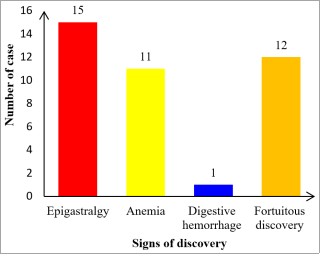
The circumstances of discovery were marked by epigastralgia (38.5%), anemia (28.2%), digestive hemorrhages (2.5%). In 30.8% of cases, gastric polyps were incidentally discovered (
Figure 1).
Figure 1. Distribution of patients according to signs of discovery of polyps.
3.3. Endoscopic Results
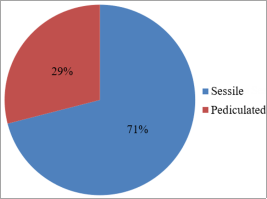
Endoscopic examination revealed that 71% of gastric polyps were sessile, while 29% were pedunculated (
Figure 2).
Figure 2. Distribution of patients according to the endoscopic appearance of gastric polyps.
3.4. Histological Findings
Histological analysis showed that gastric polyps were hyperplastic in 30.76% of cases, adenomatous in 23.07%, fibro-inflammatory in 15.38%, juvenile and fundic polyps in 12.82% each, and papillomatous in 10.25% (
Table 1). The lesion was solitary in 51% of patients, with the most frequent location being the antrum. The mean polyp size was 6.24 mm, ranging from 2 to 29 mm. No cases of associated gastric neoplasia were observed.
Helicobacter pylori (HP)-positive gastritis was associated with gastric polyps in 15.38% of cases, while HP positivity was detected in 35.89% of patients (
Table 1).
Table 1. Distribution of patients according to the histological type of gastric polyps (n=39).
Histological Type of Gastric Polyps | Frequency (n) | Percentage (%) |
Hyperplastic | 12 | 30.76 |
Adenomatous | 9 | 23.07 |
Fibro-inflammatory | 6 | 15.38 |
Juvenile | 5 | 12.82 |
Fundic | 5 | 12.82 |
Papillomatous | 4 | 10.25 |
Total | 39 | 100 |
3.5. Treatment
In addition to biopsy sampling, patients received proton pump inhibitors (PPIs) and gastric mucosal protective agents. Blood transfusion was administered in cases of poorly tolerated anemia. Patients diagnosed with Helicobacter pylori infection were treated with an oral eradication regimen for 10 days consisting of omeprazole 20 mg every 12 hours, clarithromycin 500 mg every 12 hours, amoxicillin 1 g every 12 hours, and metronidazole 500 mg every 12 hours. Regular follow-up was performed after endoscopic evaluation.
3.6. Patient Follow-up and Outcomes
The mean follow-up duration of patients was 31 months. A recurrence of polyps was observed in 5 patients among them 18.51% had no histological modification.
4. Discussion
This study, aimed at describing the clinical, endoscopic, histological, and therapeutic characteristics of gastric polyps, represents the first of its kind conducted in the Sikasso region. The majority of gastric polyps identified were benign.
Gastric polyps are most commonly hyperplastic, with malignant transformation occurring in approximately 2% of cases. Adenomatous polyps, although less frequent, are more prone to malignant degeneration
| [12] | Sanogo SD, Tayue MP, Soumaré G, Mallé O, Maiga A, Sidibé L, et al. Clinical and Anatomo-Pathological Study of Digestive Polyps at Point G Teaching Hospital. Open J Gastroenterol. 10 mars 2023 [cited 10 sept 2025]; 13(3): 111‑6. Available at:
https://www.scirp.org/journal/paperinformation?paperid=123757 |
[12]
. Despite the relatively low rate of malignant transformation in gastric polyps, it is important to recognize that the risk persists. Therefore, such lesions should not be overlooked and must be completely removed following histological confirmation, within the framework of rigorous endoscopic surveillance combined with histopathological evaluation.
The mean age of our patients was 52 years, ranging from 15 to 87 years. This finding is similar to that reported by F. Cherrafi
, who found 12.5% of patients aged 60–64 years, with a mean age of 40 years and extremes of 2 and 80 years. A similar trend has been observed in studies conducted by Bassene ML et al.
| [14] | Bassene ML, Diallo S, Thioubou MA, Diallo A, Diouf ML, Gueye MN. Gastric Polyps in a Digestive Endoscopy Center in Dakar. oct 2017 [cited 10 sept 2025]; 7(10): 279‑86. Available at: https://inis.iaea.org/records/9g4k2-mcz33 |
[14]
. This may be explained by the fact that the diagnosis of polyps is often delayed. In our study, there was a male predominance, accounting for 61.53% of cases, which is consistent with reports in the literature
| [13] | Järvinen, H. J. & Sipponen, P. Gastroduodenal Polyps in Familial Adenomatous and Juvenile Polyposis. Endoscopy 18, 230–234 (1986). https://doi.org/10.1055/s-2007-1018386 |
| [14] | Bassene ML, Diallo S, Thioubou MA, Diallo A, Diouf ML, Gueye MN. Gastric Polyps in a Digestive Endoscopy Center in Dakar. oct 2017 [cited 10 sept 2025]; 7(10): 279‑86. Available at: https://inis.iaea.org/records/9g4k2-mcz33 |
[13, 14]
. Gastric polyps were associated with gastritis in 15.38% of cases and with
Helicobacter pylori infection in 35.89% of cases. The high proportion of gastric polyps associated with
H. pylori infection in our context may be explained by the endemic nature of this infection, which can occur from childhood and remain asymptomatic. This finding is similar to that reported by Bassene et al. in Dakar, where chronic atrophic gastritis (10.8%) was the main histological lesion associated with polyps, and
H. pylori was detected in 17 patients (45.9%)
| [14] | Bassene ML, Diallo S, Thioubou MA, Diallo A, Diouf ML, Gueye MN. Gastric Polyps in a Digestive Endoscopy Center in Dakar. oct 2017 [cited 10 sept 2025]; 7(10): 279‑86. Available at: https://inis.iaea.org/records/9g4k2-mcz33 |
[14]
.
Sessile polyps were predominantly observed in 71% of cases in our study, compared with 74% reported by Cherrafi F in a study conducted in Morocco
. Histological examination revealed hyperplasia in 30.76% of polyps and adenomatous changes in 17.94% of cases. These results are comparable to findings from Dakar, where hyperplastic and adenomatous polyps predominated
| [14] | Bassene ML, Diallo S, Thioubou MA, Diallo A, Diouf ML, Gueye MN. Gastric Polyps in a Digestive Endoscopy Center in Dakar. oct 2017 [cited 10 sept 2025]; 7(10): 279‑86. Available at: https://inis.iaea.org/records/9g4k2-mcz33 |
[14]
. Similarly, Cherrafi F in Morocco (2020) reported 85% hyperplastic polyps and 10% adenomatous polyps.
In our series, most patients had fewer than three polyps, with polyps being solitary in 11 cases. This differs from the study by Bassene et al. in Dakar, where the majority of patients had solitary polyps (51%), sessile in 71 cases (83.8%), and pedunculated in 7.69% of cases
| [14] | Bassene ML, Diallo S, Thioubou MA, Diallo A, Diouf ML, Gueye MN. Gastric Polyps in a Digestive Endoscopy Center in Dakar. oct 2017 [cited 10 sept 2025]; 7(10): 279‑86. Available at: https://inis.iaea.org/records/9g4k2-mcz33 |
[14]
.
The progression of these lesions over time exposes patients to the risk of malignant transformation, particularly in adenomas, highlighting the importance of early diagnosis. In our study, the mean follow-up duration was 31 months. Polyp recurrence was observed in five patients, among whom 18.51% showed no histological changes. Gastric polyps represent a significant public health concern in our regions, where they are frequently associated with gastritis and endemic, chronic Helicobacter pylori infection, which often originates in childhood and remains asymptomatic in the majority of cases. Long-term use of proton pump inhibitors of various origins also plays a significant role among the contributing factors.
Given the potential for malignant transformation over time, especially in adenomatous polyps, early detection is crucial. This situation necessitates rigorous endoscopic follow-up and surveillance in patients with confirmed gastric adenomas, with the aim of detecting neoplasia at its earliest stage.
5. Conclusion
This study provided a comprehensive understanding of the clinical, endoscopic, and histological characteristics of gastric polyps in the population of Sikasso. Endoscopic examination revealed a predominance of sessile polyps, while histological analysis showed that hyperplastic, adenomatous, and fibro-inflammatory types were the most common. Helicobacter pylori infection remains endemic and often chronic in this region. These findings underscore the need to emphasize preventive strategies, including public awareness, early detection, prompt management, and regular surveillance of patients with gastric polyps.
Abbreviations
GPs | Gastric Polyps |
HP | Helicobacter Pylori |
PPI | Proton Pump Inhibitor |
BSG | British Society of Gastroenterology |
GC | Gastric Cancer |
Acknowledgments
The authors thank all patients and staff of the Sikasso Regional Hospital for their collaboration.
Author Contributions
Oumar Traore: Conceptualization, Validation, Visualization, Writing – original draft
Abdoul Salam Diarra: Methodology, Formal Analysis, Validation, Visualization, Writing – review & editing
Madou Traore: Supervision
Kalba Peliaba: Validation, Visualization
Mohamed Diarra: Validation, Visualization
Dramane Toure: Validation
Oumar Sangho: Supervision, Validation
Data Availability Statement
The data generated or analyzed during this study are not publicly available; however, they can be obtained from the corresponding authors upon reasonable request.
Conflicts of Interest
The authors declare no conflicts of interest.
References
| [1] |
Wu L, Zhou W, Wan X, Zhang J, Shen L, Hu S, et al. A deep neural network improves endoscopic detection of early gastric cancer without blind spots. Endoscopy. juin 2019; 51(6): 522‑31.
https://doi.org/10.1055/a-0855-3532
|
| [2] |
Corral JE, Keihanian T, Diaz LI, Morgan DR, Sussman DA. Management patterns of gastric polyps in the United States. Frontline Gastroenterol. 1 janv 2019 [cited 10 sept 2025]; 10(1): 16‑23. Available at:
https://fg.bmj.com/content/10/1/16
|
| [3] |
Morais DJ, Yamanaka A, Zeitune JMR, Andreollo NA. Gastric polyps: a retrospective analysis of 26,000 digestive endoscopies. Arq Gastroenterol. 2007 [cited 10 sept 2025]; 44: 14‑7. Available at:
https://www.scielo.br/j/ag/a/tZKKWmmXDMFBXSTyZTBF3ND/?format=html&lang=en
|
| [4] |
Argüello Viúdez L, Córdova H, Uchima H, Sánchez-Montes C, Ginès À, Araujo I, et al. Gastric polyps: Retrospective analysis of 41,253 upper endoscopies. Gastroenterol Hepatol Engl Ed. 1 oct 2017 [cited 10 sept 2025]; 40(8): 507‑14. Available at:
https://www.sciencedirect.com/science/article/pii/S2444382417301396
|
| [5] |
Carmack SW, Genta RM, Schuler CM, Saboorian HM. The Current Spectrum of Gastric Polyps: A 1-Year National Study of over 120,000 Patients. Off J Am Coll Gastroenterol ACG. juin 2009 [cited 10 sept 2025]; 104(6): 1524. Available at:
https://journals.lww.com/ajg/abstract/2009/06000/the_current_spectrum_of_gastric_polyps__a_1_year.29.aspx
|
| [6] |
Héroin L, Habersetzer F, Jacques J, Mayer P. Gastric polyps: Epidemiology, endoscopic features, and management. Hépato-Gastro Oncol Dig.; 2021 [cited 10 sept 2025]; 28(4): 491‑503. Available at:
https://stm.cairn.info/revue-hepato-gastro-et-oncologie-digestive-2021-4-page-491
|
| [7] |
Hooi JKY, Lai WY, Ng WK, Suen MMY, Underwood FE, Tanyingoh D, et al. Global Prevalence of Helicobacter pylori Infection: Systematic Review and Meta-Analysis. Gastroenterology. 1 août 2017 [cited 10 sept 2025]; 153(2): 420‑9. Available at:
https://www.sciencedirect.com/science/article/pii/S0016508517355312
|
| [8] |
Chapelle N, Péron M, Mosnier JF, Quénéhervé L, Coron E, Bourget A, et al. Prevalence, Characteristics and Endoscopic Management of Gastric Premalignant Lesions in France. Dig Dis. 25 oct 2019 [cited 10 sept 2025]; 38(4): 286‑92. Available at:
https://doi.org/10.1159/000503748
|
| [9] |
Scoazec JY. [Pre test. Gastric polyps: pathology and genetics]. Ann Pathol. juin 2006; 26(3): 157, 173‑99.
https://doi.org/10.1016/s0242-6498(06)70702-7
|
| [10] |
Han AR, Sung CO, Kim KM, Park CK, Min BH, Lee JH, et al. The clinicopathological features of gastric hyperplastic polyps with neoplastic transformations: a suggestion of indication for endoscopic polypectomy. Gut Liver. dec 2009; 3(4): 271‑5.
https://doi.org/10.5009/gnl.2009.3.4.271
|
| [11] |
Orlowska J, Jarosz D, Pachlewski J, Butruk E. Malignant transformation of benign epithelial gastric polyps. Am J Gastroenterol. dec 1995; 90(12): 2152‑9.
|
| [12] |
Sanogo SD, Tayue MP, Soumaré G, Mallé O, Maiga A, Sidibé L, et al. Clinical and Anatomo-Pathological Study of Digestive Polyps at Point G Teaching Hospital. Open J Gastroenterol. 10 mars 2023 [cited 10 sept 2025]; 13(3): 111‑6. Available at:
https://www.scirp.org/journal/paperinformation?paperid=123757
|
| [13] |
Järvinen, H. J. & Sipponen, P. Gastroduodenal Polyps in Familial Adenomatous and Juvenile Polyposis. Endoscopy 18, 230–234 (1986).
https://doi.org/10.1055/s-2007-1018386
|
| [14] |
Bassene ML, Diallo S, Thioubou MA, Diallo A, Diouf ML, Gueye MN. Gastric Polyps in a Digestive Endoscopy Center in Dakar. oct 2017 [cited 10 sept 2025]; 7(10): 279‑86. Available at:
https://inis.iaea.org/records/9g4k2-mcz33
|
Cite This Article
-
APA Style
Traore, O., Diarra, A. S., Traore, M., Peliaba, K., Diarra, M., et al. (2026). Clinical, Endoscopic, Histological, and Therapeutic Aspects of Gastric Polyps at the Sikasso Regional Hospital, Mali: A Study of 39 Cases. International Journal of Gastroenterology, 10(1), 20-24. https://doi.org/10.11648/j.ijg.20261001.14
 Copy
|
Copy
|
 Download
ACS Style
Traore, O.; Diarra, A. S.; Traore, M.; Peliaba, K.; Diarra, M., et al. Clinical, Endoscopic, Histological, and Therapeutic Aspects of Gastric Polyps at the Sikasso Regional Hospital, Mali: A Study of 39 Cases. Int. J. Gastroenterol. 2026, 10(1), 20-24. doi: 10.11648/j.ijg.20261001.14
Copy
|
Download
AMA Style
Traore O, Diarra AS, Traore M, Peliaba K, Diarra M, et al. Clinical, Endoscopic, Histological, and Therapeutic Aspects of Gastric Polyps at the Sikasso Regional Hospital, Mali: A Study of 39 Cases. Int J Gastroenterol. 2026;10(1):20-24. doi: 10.11648/j.ijg.20261001.14
Copy
|
Download
-
@article{10.11648/j.ijg.20261001.14,
  author = {Oumar Traore and Abdoul Salam Diarra and Madou Traore and Kalba Peliaba and Mohamed Diarra and Dramane Toure and Oumar Sangho},
  title = {Clinical, Endoscopic, Histological, and Therapeutic Aspects of Gastric Polyps at the Sikasso Regional Hospital, Mali: A Study of 39 Cases},
  journal = {International Journal of Gastroenterology},
  volume = {10},
  number = {1},
  pages = {20-24},
  doi = {10.11648/j.ijg.20261001.14},
  url = {https://doi.org/10.11648/j.ijg.20261001.14},
  eprint = {https://article.sciencepublishinggroup.com/pdf/10.11648.j.ijg.20261001.14},
  abstract = {Introduction: Gastric polyps are tissue lesions that develop within the gastric lumen. Their clinical, endoscopic, histopathological, and therapeutic features remain variable and poorly described in sub-Saharan Africa. This study aimed to characterize these aspects in patients at Sikasso Regional Hospital, Mali. Methods: We conducted a retrospective study over an eight-year period (2017–2024) including all histologically confirmed gastric polyps. Data were collected from medical records and analyzed using Microsoft Excel. Results: A total of 39 patients were included (24 men, 15 women; sex ratio 1.6), with a mean age of 52 years (range: 15–87). Polyps were sessile in 71% and pedunculated in 29% of cases. Lesions were single in 51% and multiple in 49%, most frequently located in the antrum. The mean polyp size was 6.2 mm (range: 2–29 mm). Histologically, hyperplastic polyps were observed in 30.8%, adenomatous in 23.7%, fibro-inflammatory in 15.4%, juvenile in 12.8%, fundic gland in 12.8%, and papillomatous in 10.3%. Helicobacter pylori infection was present in 35.9% of cases, with 15.4% showing associated gastritis. Mean follow-up duration of patients was 31 months. Conclusion: This study provided valuable insights into gastric polyps in the population of Sikasso, highlighting the diversity of their clinical and endoscopic characteristics. Helicobacter pylori infection remains endemic in this setting and is often chronic, frequently evolving asymptomatically while potentially leading to significant gastric lesions. These findings emphasize the importance of strengthening preventive strategies, including public awareness on screening, early management, and regular surveillance of patients with gastric polyps.},
 year = {2026}
}
Copy
|
Download
-
TY  - JOUR
T1  - Clinical, Endoscopic, Histological, and Therapeutic Aspects of Gastric Polyps at the Sikasso Regional Hospital, Mali: A Study of 39 Cases
AU  - Oumar Traore
AU  - Abdoul Salam Diarra
AU  - Madou Traore
AU  - Kalba Peliaba
AU  - Mohamed Diarra
AU  - Dramane Toure
AU  - Oumar Sangho
Y1  - 2026/04/16
PY  - 2026
N1  - https://doi.org/10.11648/j.ijg.20261001.14
DO  - 10.11648/j.ijg.20261001.14
T2  - International Journal of Gastroenterology
JF  - International Journal of Gastroenterology
JO  - International Journal of Gastroenterology
SP  - 20
EP  - 24
PB  - Science Publishing Group
SN  - 2640-169X
UR  - https://doi.org/10.11648/j.ijg.20261001.14
AB  - Introduction: Gastric polyps are tissue lesions that develop within the gastric lumen. Their clinical, endoscopic, histopathological, and therapeutic features remain variable and poorly described in sub-Saharan Africa. This study aimed to characterize these aspects in patients at Sikasso Regional Hospital, Mali. Methods: We conducted a retrospective study over an eight-year period (2017–2024) including all histologically confirmed gastric polyps. Data were collected from medical records and analyzed using Microsoft Excel. Results: A total of 39 patients were included (24 men, 15 women; sex ratio 1.6), with a mean age of 52 years (range: 15–87). Polyps were sessile in 71% and pedunculated in 29% of cases. Lesions were single in 51% and multiple in 49%, most frequently located in the antrum. The mean polyp size was 6.2 mm (range: 2–29 mm). Histologically, hyperplastic polyps were observed in 30.8%, adenomatous in 23.7%, fibro-inflammatory in 15.4%, juvenile in 12.8%, fundic gland in 12.8%, and papillomatous in 10.3%. Helicobacter pylori infection was present in 35.9% of cases, with 15.4% showing associated gastritis. Mean follow-up duration of patients was 31 months. Conclusion: This study provided valuable insights into gastric polyps in the population of Sikasso, highlighting the diversity of their clinical and endoscopic characteristics. Helicobacter pylori infection remains endemic in this setting and is often chronic, frequently evolving asymptomatically while potentially leading to significant gastric lesions. These findings emphasize the importance of strengthening preventive strategies, including public awareness on screening, early management, and regular surveillance of patients with gastric polyps.
VL  - 10
IS  - 1
ER  -
Copy
|
Download

 ,
Abdoul Salam Diarra
,
Abdoul Salam Diarra


 Share This Article
 Twitter
 Linked In
 Facebook